Leaving Egypt
When Israel left Egypt, everything about their day-to-day life changed.
No more would their daily work be ordered by slave drivers. No more would they live in houses or grow their own food in a vegetable patch. Instead, they would have no fixed place of abode and no clear itinerary, so they would have to deal with uncertainty and learn
many new ideas as they travelled.
God had promised to guide them to Canaan: a good, broad land;[1] a land flowing with milk and honey.[2]
God's chosen route
Yet, from the beginning, God did not lead them around the coast into Canaan, although that would have been the shortest and quickest route. Instead, he led them into the wilderness and across the Red Sea, explaining that if they went the short route and met war
immediately, they would seek the security of what they knew, even it it meant returning to Egypt as slaves.[3]
In the wilderness
In the wilderness, God provided them with water and food as he led them to Mount Sinai[4] where he proposed a covenant where he would be their God – as he had been the God of their fathers – and would give them laws to keep as a nation. All the people agreed[5] and the covenant was duly made.[6]
A
nomadic life travelling through wilderness and desert was very different from the life they were used to, and travelling in such large numbers would make the practical things of life very difficult: food collection, water distribution, cleanliness, childbirth, old age and so on.
Many of the laws God gave them were to maintain social order, some to facilitate their travels and some for when they arrived in the Promised Land. Arranging the camp during their
travels would have been very important but difficult.
Numbers of people
We don’t know exactly how many Israelites left Egypt, but we know that one year later, the number of able-bodied men ready for war who were 20 years of age or older was 603,550. Allowing for the extra males under twenty and those who were not able-bodied, the number of males would have been about 1.2 to 2 million. If the number of females was similar, the total number of people
in the congregation would be 2.4 to 4 million, or possibly even more. These numbers did not include the foreigners who escaped with the Israelites, or the tribe of Levi, which was counted separately using different criteria.
Overall, when they were camping in the wilderness, the camp layout would need to accommodate roughly 3-4 million people, which would be a logistics nightmare.
Moving millions of people from one place to
another takes significant time, and a day is not very long if people need to pack up their tents in the morning, march to another place and then set up their tents in time to sleep that night – possibly having to be ready to move on again the next day.
Organisation
To make this process easier and quicker, God specified the marching order of the tribes and the camp layout. Just imagine trying to choose a site and set up about 600,000 tents if everyone had
to choose their own camp site from a large area with no guidelines, no marked sites, no known orientation or specified neighbours. I’m very confident that it would take more than a day to organise!
God’s camp layout took away some of the uncertainty and inconvenience, so let’s look at what God specified.
Tribes
Israel was made up of twelve or thirteen tribes, depending on how you counted them. Jacob had twelve sons,
but he had also claimed Joseph’s two sons, Manasseh and Ephraim, as his.[7] That made thirteen tribes, except that in the wilderness, God claimed the tribe of Levi as his, so that they were not counted with the rest of the tribes. This choice is highlighted by the layout of the camp, where the Levites were clustered close around the tabernacle.
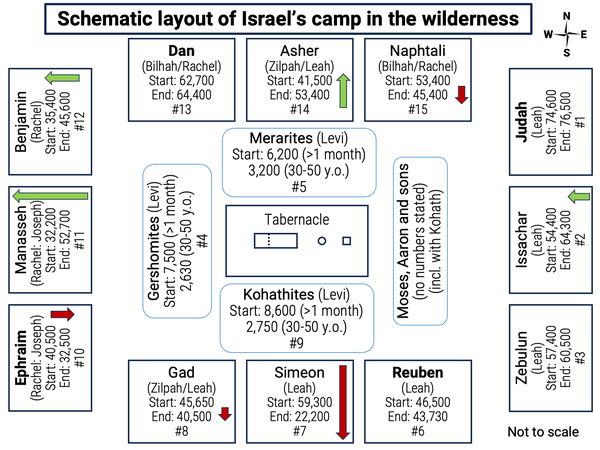
In their camp, the rest of the nation surrounded the Levites, separated into 12 tribes: three on the east,
three on the south, three on the west and three on the north, as shown in the diagram below.