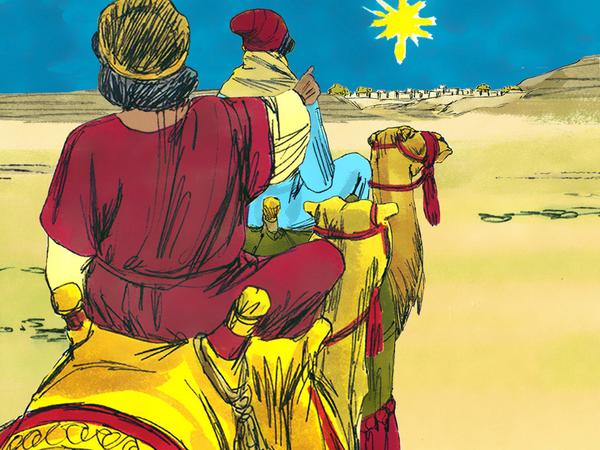
“Anyone home?” called a voice.
Joseph looked up quickly from the timber yoke to which he was applying the finishing touches. The voice sounded foreign and seemed to come from just outside.
Putting down his spokeshave, he called, “Coming,” as he left his makeshift workshop and stepped out into the darkness of the night, rubbing his hands on his leather apron.
A large group of men and animals stood outside, their faces lit by several torches.
Joseph was surprised that he had not heard their approach, but smoothing the yoke had demanded his full attention.
“I am Joseph, the carpenter,” he said, smiling questioningly at the handful of superbly dressed men who seemed to be the centre of the group.[1] “Who are you looking for?”
“We are magi from the far east. We have come to find an important child, born to be king of the Jews.” The cultured voice spoke
refined Aramaic with the accent of one from the far east.
“You look for a king here?” queried Joseph. “Are you sure?”
A second well-dressed stranger answered, “The star we were following showed us that this is the house where the child is.”
“Can we see the boy now?” said a third. “We’ve travelled a long way for this opportunity.”
“Well, you’re very welcome
here,” answered Joseph, “but I’ll have to talk to my wife first. She has been feeding the lad, but may have finished by now. Please wait.”
Joseph turned and went inside, hurrying into the main room of their small home in Bethlehem.
“Mary,” he breathed. “There’s a group of foreigners outside. Quite a few of them. They want to see Jesus.”
“I heard most of what they said,”
whispered Mary, eyes sparkling and a smile of anticipation on her face. “Where are they from?”
“Chaldea or Persia, I think,” said Joseph. “What they say matches exactly what the angel told you about Jesus. That he will reign on David’s throne over Israel.”
“Marvels just keep coming, don’t they, Joseph?” She looked down at the sleeping infant in her arms, wonder in her eyes.
“They
do. They’ve come a long way for this, so I suppose we should invite them in. Do we have any food to offer them?”
“I just took a few loaves out of the oven and some dough has been rising in the kneading basin. I can pop it in the oven right now. I’m glad I’ve been making bread this evening or we’d have nothing fresh to offer them. We can offer them some dried fish too. How many people are there?”
“More than your little loaves and half-raised dough will feed, but we can only offer what we have. If they all tried to come in at once, they wouldn’t fit anyway!”
“It’s not the first time a group has come to visit Jesus. Remember those shepherds?”
“I do. As soon as they arrived, they were trying to find ways to help us, and I suspect this group will be the same. See what you can do, Mary, and I’ll go
and invite them in.”
Mary quickly put the child in his crib where the visitors would be able to see him easily, then busied herself forming the half-raised dough into loaves while Joseph turned and went outside.
The visitors were all waiting quietly when he emerged from the house, obviously not wanting to disturb the neighbourhood, but Joseph saw that Simeon, his neighbour, was already chatting with one man, clearly sizing them all
up. The elegant clothing, gold rings and finely embroidered slippers wouldn’t escape Simeon’s notice, he knew. The entourage was certainly impressive. It looked even larger than he’d observed when he first came out to greet them. Joseph couldn’t help thinking how little food they had in the house, but he pushed the thought away. God loved hospitality and would make sure their meagre provisions stretched as far as they needed to.
“Good
news,” began Joseph, smiling broadly, and his voice carried clearly to Mary inside the house. “The boy has just finished his meal and now he’s asleep, so he’s unlikely to stir much. You can all come in and see him, but you’ll have to take turns – our house isn’t large. If you wait and enter in small groups, it will be worth the wait.”
“Thank you,” said one of the richly dressed older men who looked as if he might be the oldest. “We’ll come
in first, but I’ve no doubt that our men will want to come in when they can. We’re all very eager and excited to see this new king. Did you know that one of your own prophets spoke about him hundreds of years ago?”
“Which prophet do you mean?”
“His name was Daniel. Have you heard of him?”
“Yes, we know of him and his writings. He was a great prophet.”
“And a great leader in Nebuchadnezzar’s kingdom of Babylon, too. Clearly a brilliant man. Amazing in his wisdom and indomitable courage.”
“Well, come in, anyway,” said Joseph, stepping to one side as he held open the door.
The three oldest men trooped through the door with a few of their closest servants, leaving the rest outside. Fortunately, they were not tall men, and only Joseph had to duck under the
lintel. By the time he had followed them in and made his way around the visitors, the room felt crowded.
“Here is my wife, Mary,” said Joseph proudly. “The mother of this amazing child.”
Mary smiled, and the men dipped their heads a little in greeting.
“And here is the child,” said Joseph, indicating the sleeping form of Jesus. The young boy was sleeping peacefully, undisturbed by the
extra bustle. There was nothing unusual in his appearance – he seemed just one of any number of young boys in the district, a boy yet to reach his second birthday, but unspeakably special to his parents.
If the visitors saw anything distinctive about the child, they made no mention of it. Instead, they remarked on his restfulness and how even important leaders started off as small, defenceless children.
“What records do
you have of Daniel’s prophecies about this child?” asked Joseph.
The oldest of the leaders answered, “The most significant prophecy deals with 70 weeks of years, which is clearly 490 years. Experts in Persia had concluded that this time period was coming to an end, and in Daniel’s words they see the birth of a baby who will be king in Israel. Their arguments were persuasive, but what made it even more convincing for us three was the appearance of a sign
in the heavens. This suggested a child who would be great beyond any previous king of Israel.”
The second magi asked, “Are you familiar with astronomy?”
Joseph shook his head.
“Ah, a pity. If you were, I could describe how this celestial sign led us across vast distances to the land of Judea and to your very house.”
“Unfortunately,” said the third wise man, “the
sign was not always visible because of the cyclical nature of the movements of the heavenly bodies, and when we arrived in Judea, it was not visible for a time.”
The senior magi nodded. “Knowing that this sign related to a powerful king, we went to the king of Judea, Herod, to ask about the birth of this child.”
Joseph started. “You asked Herod about the birth of a special child?” he asked.
“Yes,” answered the leader, thoughtfully. “I’m not sure we made the best decision there. Perhaps we should have just waited, but we were eager to find this baby as quickly as possible.”
“Herod seemed shocked by our questions at first, and possibly a little suspicious,” said the second, “but he quickly called together his religious advisers, and they all agreed that other prophecies in your scriptures made it clear that we would find what we
were looking for here in Bethlehem.”
The leading magi added eagerly, “We saw the sign once more as we travelled, and it led us, first to Bethlehem, and then to your very house.”
“Amazing,” said Joseph, impressed once more by the careful arrangement of events as they related to Jesus. Then his concern about Herod prompted him to ask, “So Herod knew you were coming to Bethlehem?”
“Yes, but not
exactly where. His closest advisers knew nothing about the child, and he told us we’d have to search for the child ourselves.”
Joseph relaxed a little at this. If suspicious and paranoid Herod hadn’t dispatched any watchful soldiers with these travellers, he must have written them off as crazy religious tourists rather than believing their message.
“But he did ask us to visit him again on our way home to tell him about
what we find,” added the youngest wise man. “He said he wanted to come and see the child too.”
Cold fingers of fear clutched at Joseph’s heart. Herod wanted to come and see a new king? If any of the stories about Herod were to be believed, he would be accompanied by armed soldiers who would waste no time killing or imprisoning the child. He glanced at Mary, but she was looking adoringly down at Jesus, revelling in this interest in her
special son.
“We have some simple food here,” said Joseph, remembering his job as host and changing the subject. “Please take some of our bread and fish – and we have a little wine as well. As you eat, we’d like to hear more about your knowledge of Jesus.”
“So the child’s name is Jesus?” responded the oldest magi. “Hmm. A child called ‘God saves.’ Even more interesting. How did you choose the
name?”
“We didn’t. That is, my wife and I were each separately instructed by an angel to name the baby Jesus. So we did.”
“The name must be very important,” interjected the youngest of the magi, enthusiastically. “‘God saves.’ Surely it refers to God saving his nation, Israel? A king, perhaps, who will save Israel from the Romans?”
“Or from Herod and his family, perhaps,”
suggested the second, sardonically.
“Is either of you related to Herod?” asked the oldest.
“No. However, we are both descended from King David, Israel’s greatest king.”
“In fact,” said Mary, quietly, “if we had a king over Israel from the line of David, Joseph could well be he. The oldest son of oldest sons through many generations.”
“This is amazing,” said the
youngest, excitedly. “This series of events is no accident.”
“No,” said the oldest, slowly. “No accident at all. Over hundreds – or thousands – of years, they have all been under the close control of the God of Israel, whom Daniel worshipped.”
“Yes. Truly extraordinary,” nodded the second of the magi.
“He’s a unique child,” smiled Joseph, glancing again at Mary, “and we’re very
happy to welcome anyone who understands that.”
Notes
[1] Since the magi brought three gifts, many suggest that there were three magi. A huge body of tradition has subsequently been built around this assumption, but there is no scriptural or historic evidence for the number. Nevertheless, this story includes three magi because no other number is any more likely..