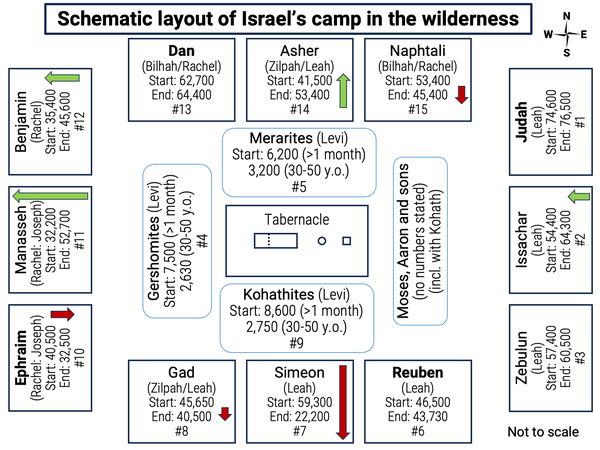
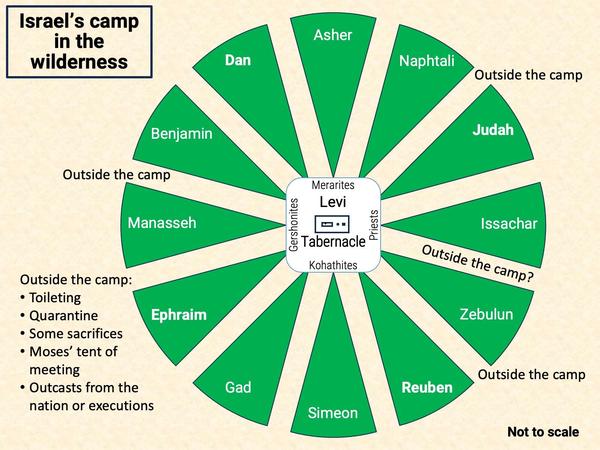
The diagram above is closer to being proportional, but is still schematic. The size of each tribe’s camp (and even the small family groupings of the Levites) would be much larger than the size of the tabernacle courtyard, so if this was a properly scaled map, the tabernacle would be too small to see.
How big was the camp?
We’re not told the physical dimensions of the camp, and if you aren’t interested in numbers and estimates, you might as well stop reading this section now! If you are, read on and see what you think.
In the previous article, we estimated about 600,000 tents in the camp. If each tent was about 10m2 (110 ft2) and we allow a similar area for spacing between tents and providing some paths, that would require 12 km2 (4.6 sq. mi.). A circular camp
of that area would be 2.6km (1.6 mi.) in radius.
Note that this gives a population density of almost 300,000 people per square kilometre (780,000 per sq. mi.) which is similar to that of the Ravensbrück concentration camp, about three quarters of the population density of the most crowded slums in the world today and much, much higher (about 40 times higher) than the Gaza strip!
Shape of the camp?
Is there any element of life
which allows us to assess whether this camp size would make life difficult or impossible?
There is one aspect of life where God’s laws would make daily life very difficult in a large circular camp: toileting, specifically defecation.
God commanded:
“You shall have a place outside the camp,
and you shall go out to it.
And you shall have a trowel with your tools, and when you sit down outside,
you shall dig a hole with it and turn back and cover up your excrement.”
Deuteronomy 23:12-13
Now if going “outside the camp” meant travelling to the outside of a circular camp, even with the densely packed camp described above, half of the population would have to walk more than 1.4km (1,500 yards) to go to the toilet and retrace their steps to their tent. No doubt this would help to keep the nation fit,
but it would be difficult to maintain.
Imagine, however, if each tribe was separate from the others, like separated slices of a cake as shown in the diagram above. In this case, “outside the camp” could include the spokes of open space that separated the tribes and led in towards the centre of the camp. In such a camp configuration the average distance for toileting would be about 400 metres (440 yards), with a maximum of about 700 metres (770 yards) –
still substantial, but much more manageable.
I’m sure the arrangement and shape of the camp would have been adjusted in various ways to make this particular restriction – with its resulting health benefits – workable.
Notes
[1] Not all of Korah’s family supported him. Some separated themselves from him and survived (Numbers 26:10-11). Eleven Psalms are declared to be written by the
sons of Korah (Psalms 42, 44-49, 84, 85, 87 and 88).
[2] The leprosy described in the Bible causes different symptoms and is thus a different disease or collection of diseases from Hansen’s disease, which we call leprosy. Hansen’s disease is not very infectious – most people exposed to it will not catch the disease.
[3] Deuteronomy 23:12-14
[4] Soldiers who had killed anyone or touched a dead body (Numbers 31:19-24); any man made unclean by a nocturnal emission (Deuteronomy
23:10-11); law-breakers being executed (Leviticus 10:1-5; Numbers 15:32-36); and possibly some foreigners (see Joshua 6:23). Also, some offerings were to be made outside the camp or some parts disposed of outside the camp (Exodus 29:14; Leviticus 8:17, 9:11; Leviticus 4:11-12; Leviticus 4:21; Leviticus 6:11; Leviticus 16:26-28; Numbers 19:2-10; Hebrews 13:11).
[5] Hebrews 13:11-14
Powerpoint slides...
The two diagrams
included in this newsletter are also attached in a PowerPoint presentation. The fonts used are embedded, so you should be able to use them without needing to install the freely available Roboto font used.
Feel free to use the slides and diagrams as you choose.
"Do all to the glory of God" (1 Corinthians 10:31)