[Continued from Part 1 & Part
2]
Saul smiled as Abner brought David into the tent. “You seem a very confident young man. You really want to fight this giant, do you?”
“Yes, my lord,” said David, standing straight and tall and doing his best to exude confidence, but squinting as his eyes adjusted from the bright sunshine to the darkness of the tent.
David saw the seated King Saul immediately, but it took a
little longer to notice the senior army commanders standing silently nearby.
“The confidence and innocence of youth,” mused Saul, stroking his beard for a few moments, before sighing deeply. He seemed to have fallen into a daydream. “Confidence… Innocence… Oh, for those days.” He sighed again and shook his head.
“Ah, yes, sir,” said Abner loudly, waking Saul from his reverie, “this lad has confidence,
alright. Faith too, I dare say. He really wants to fight Goliath.”
“You can’t fight this Philistine,” Saul told David. “You are just a youth, and he’s been a man of war from his youth.”
“My lord, your servant was keeping his father’s sheep; and when a lion or a bear came and took a lamb out of the flock, I went after him, struck him, and rescued the lamb out of his mouth. When he reared up against me, I caught
him by his beard, struck him, and killed him.”
“So, you’ve killed a lion, have you, young man?” asked Saul, impressed.
“Your servant has killed both lions and bears,” reiterated David, “and this uncircumcised Philistine will be like one of them, since he has defied the armies of the living God.”
“Yes, I suppose he has,” nodded Saul, as if that hadn’t occurred to him before.
“And the LORD, who delivered me out of the paw of the lion and out of the paw of the bear, will deliver me out of the hand of this Philistine.”
“Well, we have to admit that there’s nobody else eager to take the job,” said Saul. After pausing for a moment, he admitted, “Except Prince Jonathan, that is, and I won’t let him take the risk. So go, and the LORD will be with you. Let’s just get you some armour. Hamor!”
“Yes, sir?” answered an attendant.
“Bring my armour for this young man.”
The servant soon returned with a heavy armful of gleaming armour and began to help David into a coat of mail and a helmet of bronze. David quickly strapped on Saul’s sword over the top, but grimaced as he tried to move.
“I can’t go with these, my lord,” he said. “I haven’t tested them.” He
unbuckled the sword and gave it back to a surprised Hamor. “I’ll be fine without them.”
As David stripped off the armour, his confidence carried his audience along with him. King Saul had every opportunity to dismiss this young man with his ridiculous proposal, but somehow when David spoke, it didn’t seem ridiculous.
Saul watched him remove the heavy helmet without objection. He heard the jingling of his mail coat as
it too was discarded, and never said a word.
David had all the permission he needed: bowing to the king, he left the tent.
Out in the sunshine, crowds of soldiers stood a respectful distance from the king’s tent, eager to hear the king’s decision. Would the king risk the freedom of Israel’s soldiers – and thus the entire nation – on the untested faith of this young upstart? A murmur rose as David appeared.
“Will the king really let you go?” asked a man in the front row of the crowd.
“He didn’t try to stop me,” answered David. “So, yes, I’m going. Now.”
There were some quiet cheers and some not so quiet protests, but David paid no attention to either. He wanted to deal with this giant straight away.
Picking up the staff he had left at the entrance to the king’s
tent, he walked through the crowd, soldiers far older than himself stepping aside to give him passage. He passed through the ranks without difficulty and strode away, down the slope towards the valley.
Confidence inspires confidence. Conviction spawns conviction. Faith energises faith. One man advanced alone towards an unbalanced confrontation – but he did so with obvious belief that the unlikely outcome they all needed so urgently was not
unlikely at all. One man shouldered the hopes of a nation and carried them with a certainty that swept the onlookers with him. Others dared not face the foe themselves, but David’s easy acceptance of the burden somehow convinced them that victory was truly possible. He saw clearly God’s path to victory, and his vision led the nation that afternoon.
On the other side of the valley, Goliath was still cursing Yahweh and his army, his voice louder
than ever and his abuse suddenly cruder than ever as he strove to reclaim the attention David had stolen. If he saw the simply-dressed shepherd boy descending the slope, he gave no sign of it, and soon David arrived at the edge of the brook that sliced through the no-man’s land separating the two armies.
Climbing down the steep bank, he found a stream of cool, clear, water flowing smoothly over a bed of rounded stones among which he hoped to find some of the
ideal size, shape and weight. Hidden from both armies by the tall banks, he searched, keeping an eye on the far bank just in case Goliath came to investigate, though the man’s voice drew no nearer.
David knew just how important the accuracy of his first stone would be, so he took his time, but finally, his shepherd’s bag held five smooth stones that were as close to ideal as he could get.
As he climbed the far bank, the
Israelite soldiers saw him and a small cheer rose from their midst. His sling was in his hand and determination in his stride as he reached level ground and advanced toward the shouting Philistine.
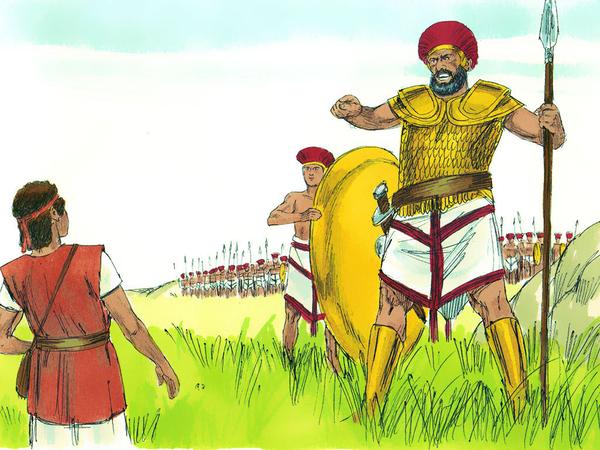
Goliath seemed to see him for the first time and stopped his bellowing in surprise. David, meanwhile, saw Goliath from close range for the first time, and there was no question about it: he was enormous! And was it really single combat when a shield
bearer protected that hulking frame?
It didn’t matter, thought David. However tall he was and however many armour-bearers surrounded him, he would get nowhere fighting God. His lumbering bulk would slow him down, and the sheer size of that massive forehead presented a bigger target than any lion or bear David had encountered.
The Philistine sized up David with disdain, his lip curling as he noted his challenger’s youth.
He observed David’s handsome, healthy face, and his own rugged, scarred face broke into a snarl.
“Am I a dog, that you come to me with sticks?”
Goliath had noticed David’s staff, but didn’t seem to have seen the sling in David’s hand. Taking his massive spear from where it was slung between his shoulders, he held it up with its threatening iron head aimed at David. Then he shook it and his fist at his puny adversary.
His heavy coat of gleaming bronze mail jingled as he cursed David by his gods.
“Come to me, and I’ll give your flesh to the birds of the sky and the animals of the field,” he growled.
David stopped. He stood still; waited for silence.
It was some time in coming, and probably only came because David finally held up his hand imperiously. The meaning was clear, and Goliath obeyed, despite
himself.
David’s voice was powerful and clear, audible to soldiers on both sides as he told the Philistine, “You come to me with a sword, with a spear, and with a javelin; but I come to you in the name of the LORD of Armies, the God of the armies of Israel, whom you have defied.”
It was almost as if David was speaking to a troublesome child who needed his failings spelled out. But his words took a far more serious turn as David
continued, “Today, Yahweh will deliver you into my hand. I will strike you, and take your head from off you. I will give the dead bodies of the army of the Philistines today to the birds of the sky and to the wild animals of the earth, that all the earth may know that there is a God in Israel, and that all this assembly may know that God doesn’t save with sword and spear; for the battle is God’s, and he will give you into our hand.”
Throughout this
verbal onslaught, Goliath stood still, silent. As it ended, his shield bearer turned to look at him, obviously expecting the signal to attack, but it was slow in coming. Goliath may have been good at the brutal art of hand-to-hand fighting, but quick thinking and strategy were not his forte.
Finally, he began to walk. He lumbered towards David with awkward steps, hampered by the weight of his equipment.
David,
however, having declared his intention, now ran nimbly towards Goliath. Free of the cumbersome weight of protective equipment and safe in the knowledge that his protection from above was better than any helmet or coat of mail could offer him, he was ready for victory.
He must get within easy range for accurate slinging, but not so close that Goliath would feel confident enough to throw his javelin. And he couldn’t ignore that shield-bearer either: he
knew that such men were often expert warriors in their own right, not to be trifled with. Speed would be of the essence. As he ran, he felt in his pouch for the first stone. He felt no need to choose the best – he would rely on God selecting the one that would fly most truly to the target and silence that cursing mouth forever. The stone felt smooth and heavy in his hand as he quickly fitted it into the pocket of his sling.
Many slingers
stand still to optimise accuracy, but David was used to loosing on the run and was confident that Goliath’s broad, slow-moving forehead would be an easy target. He swung the sling one full circle and let fly. The stone flew with shocking speed and struck Goliath in the middle of his forehead, between the bronze helmet and his eyes. As he ran, David saw it sink in, saw Goliath’s eyes roll up in his head, saw his legs collapse beneath him and watched his gigantic body crash to
the ground, full length, face down. The bronze helmet slipped off his head and rolled a little way towards David.
Goliath’s shield-bearer heard – and probably felt – the giant’s fall and turned back in uncomprehending shock. As he did so, David sprinted past him and leapt over the fallen body, placing it between himself and the stupefied shield-bearer.
Was Goliath dead? David didn’t know, but it would be best to make
sure he was, and prove to the watching Philistines that their giant was finished. Grasping the hilt of Goliath’s sword, he dragged the heavy blade out of its sheath. Had the giant moved? Had the stone only stunned him? David swung the sword high and brought it down on the unprotected back of Goliath’s neck. His timing was perfect, and the gleaming sword cut through that massive neck as it if were butter.
Goliath’s shield-bearer stood
not far away, shocked at the astonishing speed of his master’s downfall, but as David reached down to lift the giant’s head aloft, he seemed to wake. In a moment, he swung Goliath’s massive shield in front of him and reached for his sword. When David straightened and took a step towards him, however, he dropped the heavy shield and ran, evading David and making for the Philistine lines.
David let him go, then, reaching down again, grabbed Goliath’s hair
and raised the enormous severed head high, displaying it to both armies. Goliath had paid the ultimate price for cursing the God of Israel, and everyone must know it.
Shouts of joy were already spreading through Saul’s army, but when they saw Goliath’s head, everyone cheered and waves of soldiers began to pour down the hill towards the stream.
Meanwhile, the Philistine camp was filled with consternation. Panic spread with
shouts of dismay. Their champion was dead, and within moments, the army was melting away. Goliath’s statement that the Philistines would be Israel’s servants if he lost was forgotten as they all ran for their lives.
Shouting with triumph, the men of Israel and Judah crossed the stream, calling their congratulations to David as they hurried past, bent on pursuing the Philistine army.
It was a stunning victory, but David did
not join in the pursuit of the Philistines. First, he prayed, thanking God for his protection and guidance. Then Saul’s servant Hamor called him to see the king and helped him carry Goliath’s armour and weapons. David also carried Goliath’s gruesome head as they crossed the stream and climbed the hill to the almost-empty Israelite camp. Recalling the day Samuel had anointed him to replace Saul as king, he realised that he had now taken the first step of leading God’s
nation in faith – as he must. The Philistines had been taught a lesson, and suddenly he saw another opportunity as well. Melchizedek, the priest of God Most High in Abraham’s day, had been king of Salem, the city now called Jebus under the rule of the Jebusites. When he ruled Israel, David planned to take this great city and rename it “Jerusalem”. Displaying Goliath’s head on a pole outside the city would be an appropriate low-key announcement of his plan.
Saul need know nothing about it, but David was sure the Jebusites would understand the veiled threat.
Goliath’s weapons and armour, he would keep. And he planned to stay the night as Jesse had said he could.